|  Let’s
face it, teachers are entertainers. We are performing our
lessons for an audience of students. We are forced into this
role because our job requires that we keep the students engaged,
in order for them to learn. I may not intend to do it, but
I find myself making stupid jokes and exaggerating otherwise
boring stories to get some laughs. I also try to participate
in the activities that I assign them. If they see my motivation
level, it encourages them to do well too. All this adds to
the atmosphere and makes teaching more fun for both the teacher
and the student. But there are other ways to captivate students
besides putting on a show, by getting them hooked on learning.
This is the method I am most comfortable doing and it is part
of my philosophy of teaching. Let’s
face it, teachers are entertainers. We are performing our
lessons for an audience of students. We are forced into this
role because our job requires that we keep the students engaged,
in order for them to learn. I may not intend to do it, but
I find myself making stupid jokes and exaggerating otherwise
boring stories to get some laughs. I also try to participate
in the activities that I assign them. If they see my motivation
level, it encourages them to do well too. All this adds to
the atmosphere and makes teaching more fun for both the teacher
and the student. But there are other ways to captivate students
besides putting on a show, by getting them hooked on learning.
This is the method I am most comfortable doing and it is part
of my philosophy of teaching.
I believe in a process-centered approach to teaching art. My goals are to teach students how to think, how to plan, how to observe, how to produce visual stories, how to imagine, how to compose, how to design, and how to create to solve a problem. Some art teachers that have observed at the elementary level, showed finished art examples before the students even started doing the artwork. I also started this doing this because from I thought this was the only way that worked when you have such short blocks of time with them and don't see them everyday. But when students were walking up to me constantly asking, "Mrs. Klinger, is this done yet?" I realized that they were doing art for my approval instead of making it their own. Now I try to only use demonstrations to show how to use materials, instead of how to create the art. Then I follow immediately with a hands-on activity. Doing it seems to be more effective than watching it. In order to prove this theory, I taught a unit on bookmaking using three different approaches based on multiple intelligences. Since the book making process relied on a lot of specific directions, it was a good candidate for observing how students comprehend visual directions versus actually acting it out themselves. Now when a student asks "is this done yet?" I can respond, "Do you think so?"
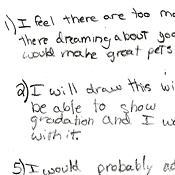
When I create criteria for a lesson to meet, I try to make the objectives based on completing all the steps instead of what the final product should or shouldn't have. In this way, students can meet the results in many different ways. I spend a lot of effort on being clear about the kind of thinking practice they will need to come up with an end product to take pride in. I give them time for preliminary practice to build confidence and to clarify what it expected. I encourage students to make lists and/or sketches. This leads to students try to push
the limits of the problem and therefore come up with a more creative and individualized product. For example, if I am teaching a very difficult concept
about how sound and images work together, one of my lessons
objectives would be just that statement, not a detailed description
of how they are going to meet that goal and what materials
they will use. I used this approach for a similar lesson in
my Videography class. My assumption was that all the students
would be comfortable using drawing materials to convey their
design solution. For a group of students that struggled with
drawing, they had a very difficult
time getting started. I stood in front of the class and
did a little dance. I then told them to open their minds and
said that as long as they could explain their solution, even
a dance could meet the requirements. The struggling group
expanded on my idea and ended up acting out their “design,” and it was the strongest piece of work created.
“Think left and think right and think low and think high. Oh, the thinks you can think up if only you try.”
~ Dr. Seuss
|
|
This example taught me two things. Never underestimate my
students and leave room in my lesson plans for their creativity.
Just because I am the one titled the “art teacher,”
does not mean I am them most artistic one in the room. I also
learned that student’s instinct is to first look at
what every one else is doing or try to figure out what I am
looking for and use that as a base idea. To combat this nature,
I found it helpful in certain lessons to avoid showing them
an final example, have students start out with individual
sketches and then separate groups into different rooms to
avoid limiting their vision. Captivating students with an
interesting lesson, then keeping them interested by letting
students make the lesson their own, I believe is important
to my philosophy of teaching.
|