ART FOUNDATION: INTRODUCTION TO SCULPTURE |
|
Lesson 4: What would your bug look like?
Soda Can Bug Activity, Final Assessment -Poem
Introduction:
There are certain tools that sculptures use to make their work more interesting. It is always beneficial for students to look at professional artist's work for inspiration and show them how other artists interpret the world around them.
Vocabulary List:
Sculpture, Carved, Modeled, Constructed, Cast , Relief, Medium, Bronze, Plane, Volume, Welded, Segments, antennae, appendages, thorax, exoskeleton, abdomen, dorsal, mimicry, ommatidia, network.
Concepts: Self-defense, Movement, Additive, Subtractive, Medium, Negative Space, Open, Closed, Free-Standing, Texturized, Dimensional.
Goals:
- Visualize art in natural forms such as insects
- Learn how to re-use materials that surround them every day
- Feel the limitations and possibilities of different materials
- Understand the sculpture medium and be introduced to basic terminology
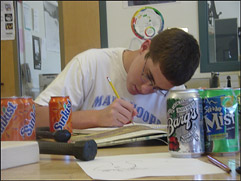 Materials: Materials:
- Glue guns and hot wax
- Metal scissors that will cut metal
- Wire cutters
- Rubber tipped hammers (to flatten sharp edges)
- Pliers (to bend wire)
- 3 soda cans per student
- Many types of wire
- Laminated bug photos
- Compass and piece of soft wood (to punch holes)
- Paul Fleischman (1988). Joyful Noise. Harper & Row, Publishers. USA.
Sequence of Activity:
- Have each student bring 3 soda cans to class. Must be the thin aluminum.
- At each table of 4, students will share materials.
- Make sure each student has at least 3 soda cans.
- Give short introduction about project:
- Art can be seen in insects by looking at their complex shapes.
- When creating sculpture, it is important to capture the basic information about insects and their major characteristics, but also do your own interpretation.
- Sculpture can be created in many different mediums (materials). Metal is very popular and this lesson requires the use of aluminum and wire.
- Hand out Assignment and review requirements
- Distribute insect resources (laminated photos, books, internet).
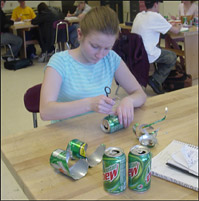
- Demonstration of cutting the cans and safety issues
- Hammering edges
- Show the joints and various ways to get the metal to hold together (flat surface - tabs, splice and bend).
- Show examples of bugs already created - Cut out a form and add on a form.
- Studio work time
- Have the students try to start with a sketch.
- Encourage them to destroy and mangle the cans.
- Remind them to think about overall size, color and pattern.
- Throughout the process, have them stand back and assess from all angles.
- The aim is to draw the viewer into the sculpture's unique complexity.
- Clean up - store working artwork in bags with labels
Requirements:
- Must use at least one can
- Can only use aluminum can and wire
- Must be free-standing unless it is flying
- Sturdy - should not break if dropped
- Have at least 10 added parts
- Have at least 3 cut away parts
- Must be interesting from all sides
- Make aesthetic choices about color
Assessment Critique and Poem Activity: This is a great project to create an installation out in a courtyard of the school. Bugs can be hung from trees, or sat on benches and rocks.
- Share some poems about bugs from the book Joyful Noise. Have each student look at their finished work and create a Haiku about their work for the next class. Poem should be typed and placed on a card next to their work. They should incorporate at least 3 vocabulary terms.
- Next class. Have students look at the finish work of the class and do an oral critique of basic sculpture terms and which pieces are most interesting and why.
- Questions to discuss:
- Did the form change from the concept to the final product? Why?
- What choices did the materials force you to make?
- What elements and principles of design were used?
- What did you learn about insects and their forms? What are the focal points?
- Assess individual sculptures using a rubric that evaluates creativity, elements and principles, craftsmanship, time and effort, and durability.
|

